The Neurobiology of Rigor in IB Contexts

How should we define rigor in an IB context and how can we cultivate the conditions necessary to enable it?
There is a question I have been unable to satisfactorily address throughout my career so far: how do we maintain the high academic standards the International Baccalaureate (or any curriculum) demands without harming the very students we are trying to empower? As I suspect is the case for most people working in education, this is the kind of question that tends to flit around the edges of one's consciousness whilst focusing on more urgent matters. It comes up in staff meetings and curriculum reviews and while reflecting on how various school initiatives are proceeding, but the concept of "positive rigor" usually feels too vague or too "high concept" to make any sort of concrete start on addressing.
Coincidentally, I was asked to present on just this topic at the 2026 IB Association of Japan engagement event in Tokyo, and preparing for that talk forced me to do something I had always thought about but never actually done: take the time to deeply research and synthesize what "rigor" means, properly and scientifically, drawing on what the research now tells us rather than on the accumulated assumptions of a profession that can often lean on "common knowledge" or personal wisdom to address such issues. What I found was both clarifying and, in some respects, a bit unsettling, because it suggests that many of the strategies we tend to reach for when we want to demonstrate academic seriousness are not just unhelpful but are, in an empirical, neurobiological sense, actively counterproductive to learning and sometimes harmful to students.
The presentation:
This article is an attempt to organize and articulate the research I conducted and my interpretation of "what it all means", and what educational leaders might do going forward to address some of the most pressing imperatives.
Disclaimer: I am not an expert in the neurological, cognitive, or behavioural sciences, and the research I was able to conduct (and my understanding of it all) may include gaps. Nonetheless, I feel I have a much clearer grasp on the core considerations - and strategies for addressing them - than I did before setting out on this exploration, and I belief this is worth articulating and sharing in my own words.
If that interests you, please read on.
Table of Contents
The word we haven't examined
"Rigor" functions, in most IB conversations I have been part of, as a term of approval that has quietly absorbed the meanings of adjacent concepts - difficulty, volume, challenge, endurance - until it is doing too much conceptual work to mean anything precise. When a school culture celebrates how much homework it assigns, or measures its seriousness by the percentage of students who struggle, it has conflated suffering with learning. These are not the same thing, and the conflation has real costs.
The cognitive science and neurobiology of the last decade have made this conflation increasingly difficult to sustain intellectually. The research is not subtle on the point. John Sweller's work on Cognitive Load Theory, now several decades old but still productively evolving, draws a sharp analytical line between the kinds of cognitive effort that produce learning and those that merely exhaust the learner without producing any corresponding growth in understanding (Sweller, 2023).
In his framework, germane load - the effortful construction of new schemas, the active reorganization of prior knowledge - is what rigor should mean. Extraneous load - the overhead of navigating a confusing assignment brief, decoding an inconsistently formatted LMS, trying to infer what the teacher wants from a rubric that uses a dozen command terms interchangeably - is what we often mistake it for. The two feel similar from the outside. They feel similar from the inside too, to a student who simply experiences both as "hard." But they produce entirely different outcomes, and treating them as equivalent is a category error with significant consequences for instructional design.
More recent work has pushed this further by connecting the cognitive science to the underlying neurobiology of the adolescent brain under stress. A 2025 study in Frontiers in Psychology on the neurobiology of academic stress in adolescents found that chronic stress does not merely "feel bad" - it physically remodels the brain, strengthening the amygdala's role in information processing while impairing the prefrontal cortex (Guo et al., 2022). This is not a temporary state that resolves when the stressor is removed. In adolescents - whose brains are still developing and whose regulatory architecture is considerably more vulnerable to stress-induced structural change than adult brains - chronic academic pressure can produce lasting shifts in the relative dominance of these neural systems. The research on adverse childhood experiences and brain development makes the same point with somewhat grim clinical detail (Perry & Szalavitz, 2017): the developing brain is shaped by its environment, and schools are environments.
If you want a mental image of what this means practically: the brain that the IB most needs - analytic, evaluative, capable of sustaining a multi-paragraph argument or a nuanced TOK essay - is the prefrontal cortex. Chronic stress progressively locks that brain region out of the cognitive loop. The student is still there. The cognitive architecture you need them to use may not be available.
"Rigor is not about how much a student can suffer. It is about how deeply they can think while their brain is in an optimal state for learning."
That is the working definition I want to offer, and it has consequences that touch virtually every aspect of school design - from the structure of the school day to the language of assessment rubrics to the way we communicate with parent communities about what excellence actually looks like.
Many of those reading this article will by now be chafing at the implied accusation that they have ever, at any point, intentionally positioned "suffering" as a goal of any learning activity or assessment. However, according to scientific definition and what research tell us, practically speaking much of what traditional educational models create as a side effect of their approaches to learning and assessment is a form of neuro-biological suffering in students.
The hierarchy the brain insists on
The most important single idea from the neuroscience of learning for school leaders - and one of the most consistently ignored in practice - is that the brain is a hierarchical organ, and it processes information from the bottom up. This is not a metaphor or a loose pedagogical framework. It is the actual sequence in which neural activation propagates through the brain's structural architecture.
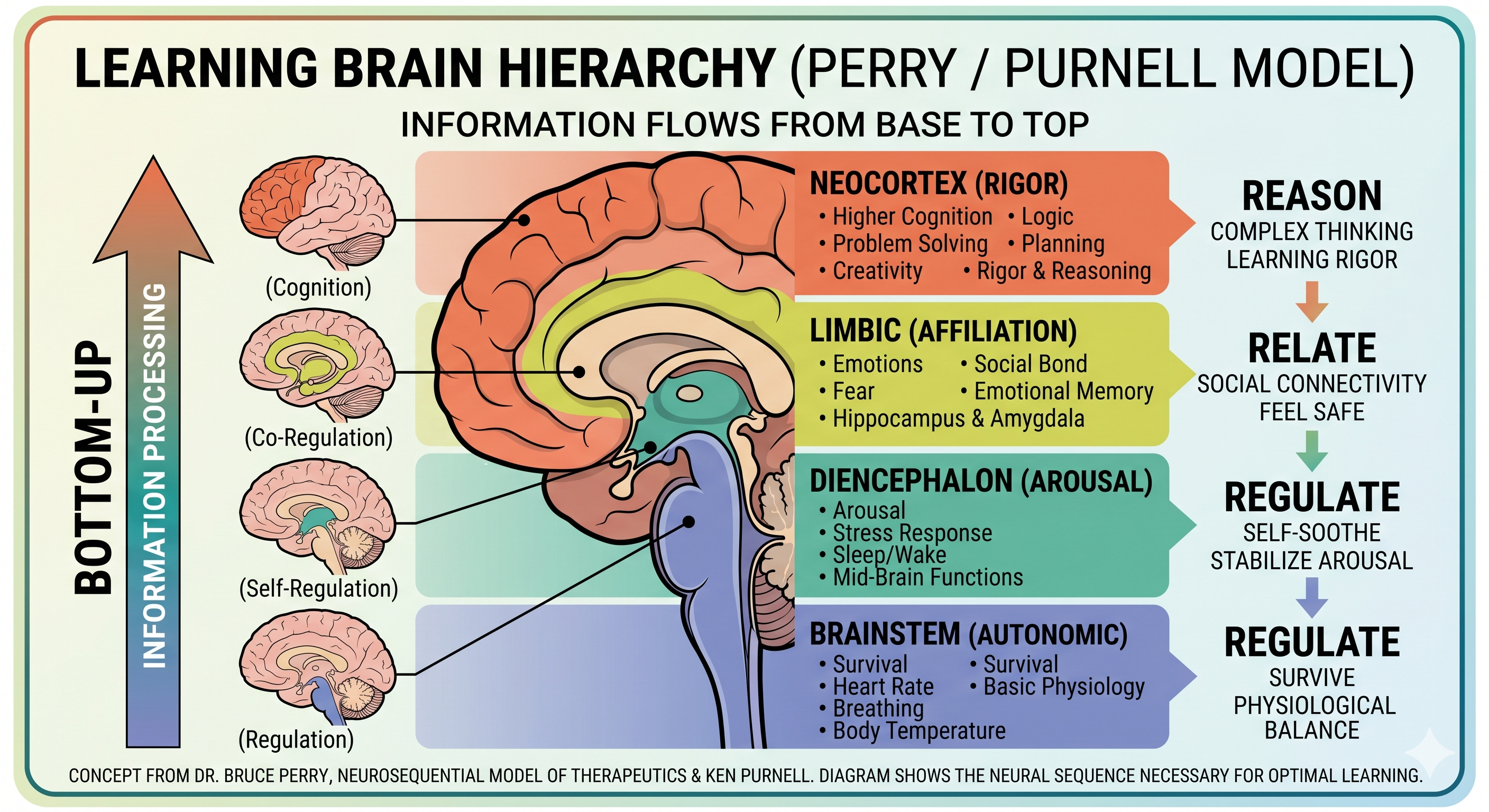
Bruce Perry's Neurosequential Model of Education describes this hierarchy clearly: the brainstem regulates basic arousal and survival responses; the diencephalon coordinates sensory input and motor function; the limbic system processes emotion, memory, and threat; and only above all of that - only when the lower regions are sufficiently settled - can the cortex properly engage with abstract reasoning (Neurosequential Network, n.d.).
Perry's "Regulate, Relate, Reason" sequence is not a pedagogical nicety. It is the order in which the brain actually becomes available for learning. This matters enormously for how we should think about classroom culture, transition routines, advisor relationships, and the ambient emotional register of a school.
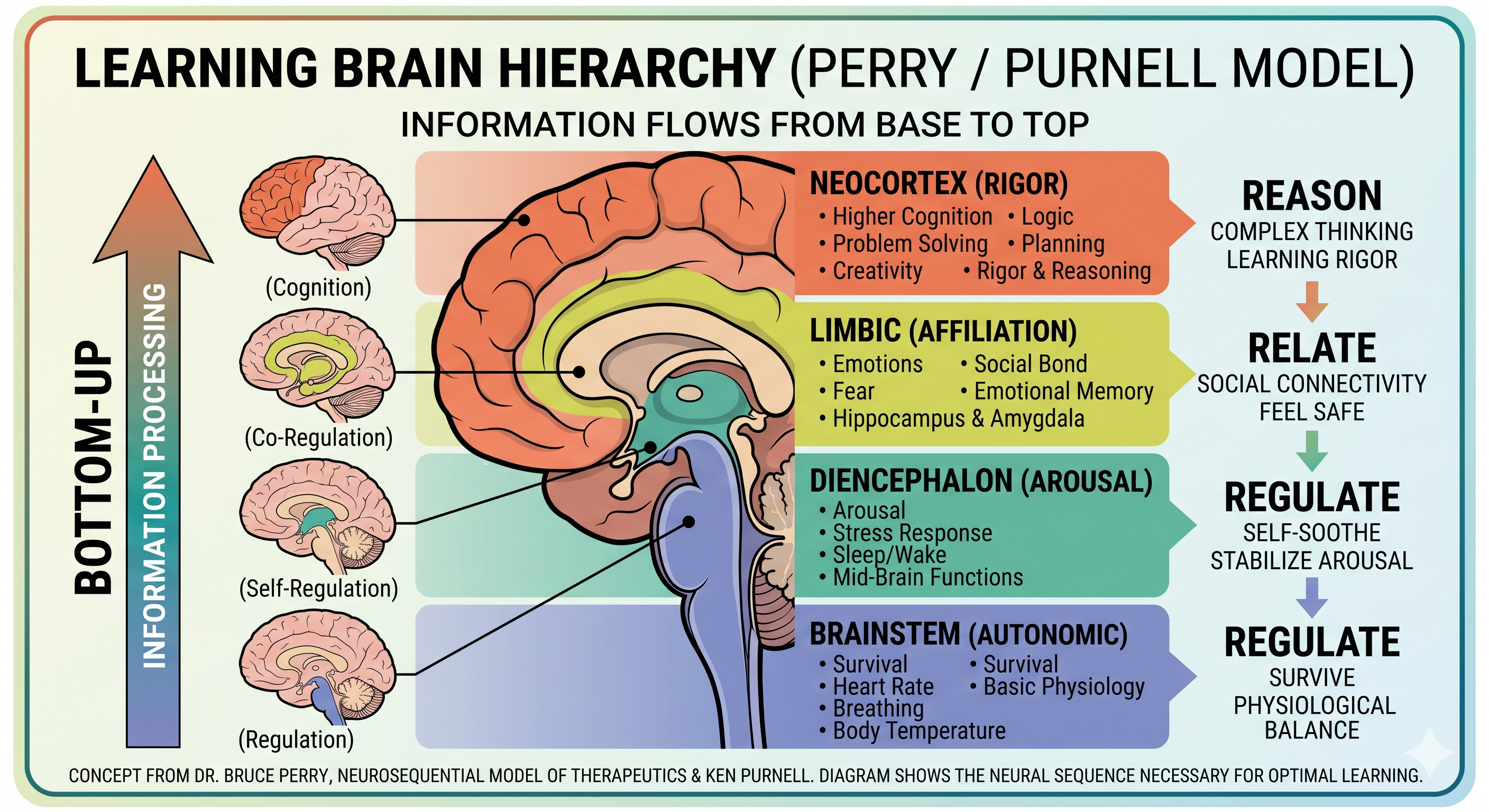
A student who arrives at a lesson in a state of dysregulation - anxious about an overdue assignment, running on five hours of sleep after a Juku session, carrying the fear of a grade that defines their perceived worth to their family - is not a student who can simply choose to engage with the epistemological problem on the whiteboard as soon as they sit down in class. The "regulatory deficit" is upstream of the reasoning. No amount of good teaching at the level of content will compensate for a brain that cannot access the cognitive systems that the content requires. This is what Perry means when he talks about the futility of trying to reach children through "cortical instruction" when they are operating from a subcortical threat state (Perry & Szalavitz, 2017). A class that begins lessons without any regulatory transition, for example that moves straight from the hallway into complex content, is operating in ignorance of this sequence.
Ken Purnell's recent work in educational neuroscience adds important precision here, particularly on the neuroendocrinology of stress in learning contexts (Purnell, 2025). The relevant finding is not simply that stressed students perform worse - which any experienced teacher knows intuitively - it is that cortisol-mediated stress impairment is not uniform across cognitive task types. High-cortisol states tend to preserve procedural, rote, and pattern-matching performance - the kinds of tasks that can be completed through the lower brain regions - while specifically impairing the higher-order functions that depend on prefrontal engagement: analysis, synthesis, evaluative judgment, counterfactual reasoning, and metacognitive reflection.
This is a finding with direct and underappreciated implications for IB assessment design. The IB's own command terms - "evaluate," "justify," "to what extent," "discuss the implications of" - are a taxonomy of precisely the cognitive operations that high-cortisol impairment targets most specifically. In other words, the most challenging assessment objectives are the most stress-vulnerable. A school environment that generates chronic baseline stress is not merely creating unhappy students; it is specifically degrading its students' capacity to perform on the assessments that define the programme. The two are working against each other in a way that is not metaphorical but concrete and mechanical.
The "cognitive tax" we keep levying
The neurobiology connects to a separate but overlapping body of work in cognitive science that has practical implications for school leaders at the level of instructional design and school operations. Cognitive Load Theory's central contribution - now extensively validated across educational contexts - is the insight that working memory is severely limited in capacity, and that this limitation is the primary constraint that instructional design must respect (Sweller, 2023). The question that this forces is not "how difficult is this material?" but "what is the total cognitive demand being placed on the learner, and what portion of that demand is actually producing learning?"
The distinction between intrinsic load (eg. the inherent complexity of a TOK knowledge question), extraneous load (the overhead of navigating a confusing assignment prompt or a poorly organized LMS), and germane load (the productive effort of constructing new understanding) is not merely theoretical. It maps directly onto decisions that school leaders and teachers make every day. When an assignment brief is ambiguous, when assessment criteria shift between teachers, or when the digital environment requires students to click through multiple platforms to complete a single task, the extraneous load accumulates invisibly, and it competes directly with the germane load that actually develops the capacities we care about (The Learning Agency Lab, 2020).
In my work running an online learning environment, I have seen this more clearly than I might have in a conventional on-campus school environment. When the interface is the environment, because every interaction with the curriculum is mediated by a screen, the extraneous load problems are impossible to miss. Students who are capable of sophisticated inquiry can spend the majority of their cognitive energy on logistics: where is the assignment? What format is expected? What does this feedback comment mean? That is not their failure. That is a design failure, and it falls on the school.
The Learning Agency Lab's applied research on CLT in practice documents that the gains from reducing extraneous load are particularly pronounced for students who are already working close to their cognitive capacity, which in something like a demanding IBDP program, with its simultaneous Internal Assessment timelines, CAS commitments, Extended Essay milestones, and Theory of Knowledge requirements, describes a significant portion of any cohort during the academic year's peak periods (The Learning Agency Lab, 2020). Reducing extraneous load is not a concession to weakness. It is a deliberate reallocation of finite cognitive resources toward the purposes the curriculum is actually designed to serve.
The OECD Learning Compass 2030 framework describes this concept a bit differently but in a highly compatible way. The framework identifies that student agency - the capacity to navigate one's own learning with direction and self-regulation - is the central competency that education systems need to develop (OECD, 2019). Agency is not possible in a cognitive environment saturated by extraneous demands. A student whose working memory is perpetually consumed by the administrative overhead of schooling cannot be the self-directed inquirer the IB Learner Profile describes. The structural conditions for agency have to be deliberately designed. They do not emerge spontaneously from a high-expectations culture.
Time as a structural variable
Perhaps the most contested area of school reform - and the one where the gap between evidence and practice remains widest - is the organization of time. The research from Stanford's Challenge Success program and from the literature on adolescent chronobiology is consistent and has been consistent long enough that continued ignorance of it has become, at this point, difficult to defend as accidental (Challenge Success, 2024; Wheaton et al., 2016).
The adolescent brain undergoes a genuine biological shift in circadian rhythm at puberty that pushes the natural sleep and wake cycle roughly 90 minutes to two hours later than in childhood or adulthood. This is a neurological change - not a behavioral preference or an "attitude problem". This shift is driven by changes in melatonin secretion timing and is well-documented in the literature. Research on school start times documents the downstream cognitive effects of misalignment between schedules and adolescent sleep phase: impaired working memory, reduced executive function, lowered frustration tolerance, and compromised emotional regulation - all before the first lesson of the day begins (Wheaton et al., 2016). Asking a 17-year-old to perform high-order DP Mathematics at 8:00 AM is the chronobiological equivalent of asking a middle-aged adult to perform the same task at 3:00 AM. That analogy is not hyperbole. It is the direct implication of what the data says.
Reporting in The Atlantic adds a finding that should give pause to school leaders who worry that structural reforms will come at the expense of academic outcomes: several schools studied that reduced homework loads by as much as 50% reported subsequent improvements in standardized test performance, not declines (Denizet-Lewis, 2019). The mechanism there seems consistent with what CLT would predict - when students have adequate recovery time, their working memory is less depleted during instructional periods, and the learning that does occur consolidates more effectively. Less total volume, more total learning. The seemingly counterintuitive direction of that finding is actually exactly what the neuroscience would lead us to expect, and it is exactly what most school leaders' intuitions push against.
Challenge Success's research on deadline clustering - like the accumulation of major assessment tasks in the IBDP's February-to-May period - documents a specific impairment to work quality, not just student comfort, as students transition from genuine inquiry into survival mode (Challenge Success, 2024). The IB's external examination calendar constrains some of this. Internal assessment milestones, mock examination scheduling, and formative deadlines are within every school's control. How schools use that control is a structural choice with real consequences for the quality of learning that occurs in the programme's most demanding stretch.
Technology in the right register
The conversation about AI in education has largely proceeded between two unhelpful poles: uncritical enthusiasm and reflexive prohibition. Both miss what the emerging research actually shows, which is that the value of AI as a pedagogical tool depends almost entirely on whether it is deployed to reduce extraneous cognitive load and scaffold access to germane load - or whether it is used to bypass the productive struggle that germane load represents.
A 2026 study in Education Sciences on AI-integrated scaffolding in K-12 settings found that conversational AI agents, deployed at the right moment in a student's workflow, can function as what the researchers describe as "stress buffers" (Rind, 2026). These tools provide responsive, low-judgment feedback at the point of need that prevents the frustration-to-shutdown pipeline that frequently derails extended projects like the Extended Essay or Internal Assessments. The blank page is not merely emotionally difficult; it is a genuine working memory problem, because the student's cognitive resources are consumed by uncertainty about how to begin, leaving nothing available for the actual intellectual work. A scaffold that removes that specific bottleneck without bypassing the inquiry it is designed to enable is legitimately useful.
The misuse case, which is widespread and accelerating and is - rightfully so - a major topic of concern inside schools and in public discourse, is technology deployed to replace thinking rather than to enable it: AI that generates first drafts, tools that assemble answers rather than support their construction, systems that intercept the productive struggle through which understanding actually develops. The distinction matters enormously and is worth insisting on clearly, even in an environment where the boundary is under continuous pressure from both students and, increasingly, from market forces. Exactly how technology providers and schools develop and deploy AI tools for maximum cognitive benefit - while reducing misuse rates - is outside the scope of this article, but is something to keep an eye on as this area continues to develop.
What seems most promising as a model for IB schools is the use of predictive analytics on student engagement and well-being patterns - not as surveillance, but as a distributed early warning system. The engagement data that schools already collect through LMS interaction logs, assignment submission patterns, and pastoral check-in systems contains illuminating and actionable information about which students are approaching a cognitive or emotional threshold. Most schools lack the analytical infrastructure to read that signal in real time. Building it is not a technological luxury - it should be thought of as a well-being intervention with a better evidence base than many of the pastoral programmes schools currently invest in (ie. the "vibes-based" approach).
The metacognitive lever
Across the six areas I examined in preparation for my IBAJ presentation, the intervention with the most robust evidence base - and, in my view, the most systematically underinvested area in IB schools - is metacognition.
The Education Endowment Foundation's guidance report on metacognition and self-regulated learning synthesizes decades of experimental evidence and identifies this as among the highest-impact, lowest-cost interventions available to schools, associated with approximately eight additional months of learning progress when implemented systematically (EEF, 2025). The mechanism is not mysterious. Students who can accurately assess what they know, identify precisely where their understanding breaks down, select and apply appropriate repair strategies, and monitor their comprehension as they move through new material are students who are less dependent on external regulation and more capable of the kind of sustained, self-directed inquiry that the IB programmes nominally demand. They are, in other words, exactly what the Learner Profile describes as a Reflective, Inquiring Thinker, and they arrive at that description through a developmental process that has to be explicitly taught, not merely expected.
The gap between aspiration and practice is worth naming directly. Most IB schools endorse these qualities rhetorically. They appear in mission statements, admissions literature, and the learner profile posters in every corridor. Fewer schools have built explicit, sequential instruction in metacognitive skills into the curriculum in the way the EEF recommends: through structured lessons that teach planning, monitoring, and evaluation as transferable cognitive tools, not merely as one-off strategies deployed in a single subject. Harvard Project Zero's "Making Thinking Visible" framework offers one practical entry point: structured routines (See-Think-Wonder, Claim-Support-Question, the Ladder of Feedback etc.) that make the process of reasoning legible to both students and teachers, rather than leaving it as an invisible internal event that either happens or doesn't (Harvard Project Zero, 2025). These routines function as metacognitive scaffolding: they make the internal habit of self-monitoring into an explicit, practised, socially reinforced activity.
There is also a specific connection to assessment design worth making. When failure is terminal, for example when a draft IA or a practice essay exists only to be graded and filed, without any structured opportunity for revision informed by that grade, we have built a system that punishes precisely the kind of error-detection and self-correction that metacognition depends on. Iterative assessment, the capacity to revise and resubmit based on feedback, transforms failure from a shame event into a data point. This is not a lowering of standards. It is a closer approximation of how knowledge actually develops in practice, and of how the professional, academic, and creative contexts our graduates will inhabit actually function. Scientists iterate. Writers revise. Engineers prototype and test. The IB is preparing students for exactly those contexts, while frequently using assessment practices that bear no resemblance to them.
The Japanese context
Working in Japan adds a particular layer of complexity to all of this that deserves its own dedicated section in this article rather than a footnote. The MEXT Fourth Basic Plan for the Promotion of Education (2023–2027) has placed well-being and ikiru-chikara - the "zest for life," encompassing the capacities for self-directed agency, emotional regulation, and adaptive resilience - at the official center of Japan's national educational objectives (MEXT, 2023). This is significant not merely as policy alignment but as cultural signal: it indicates that the tension between academic performance pressure and student flourishing has been recognized at the highest levels of the Japanese educational system as something that requires structural response, not just pastoral care.
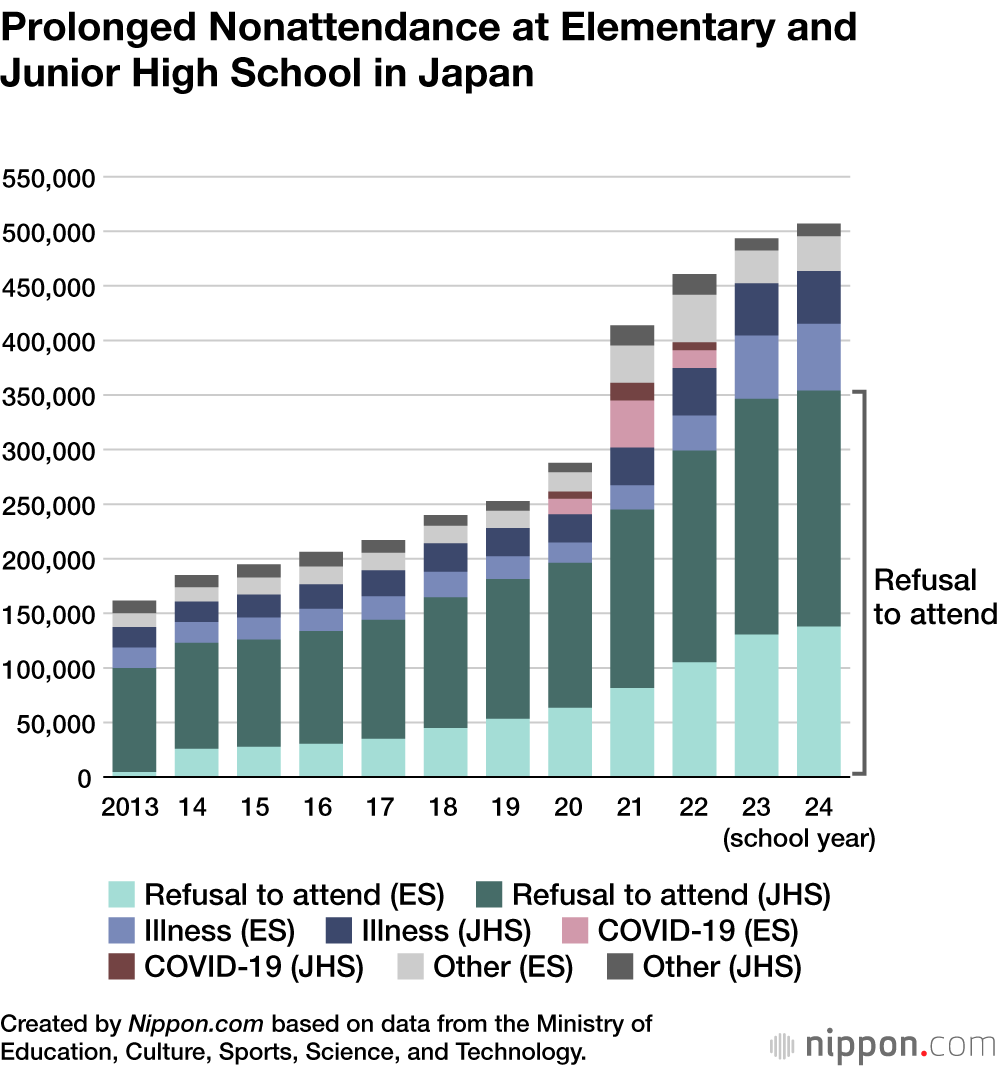
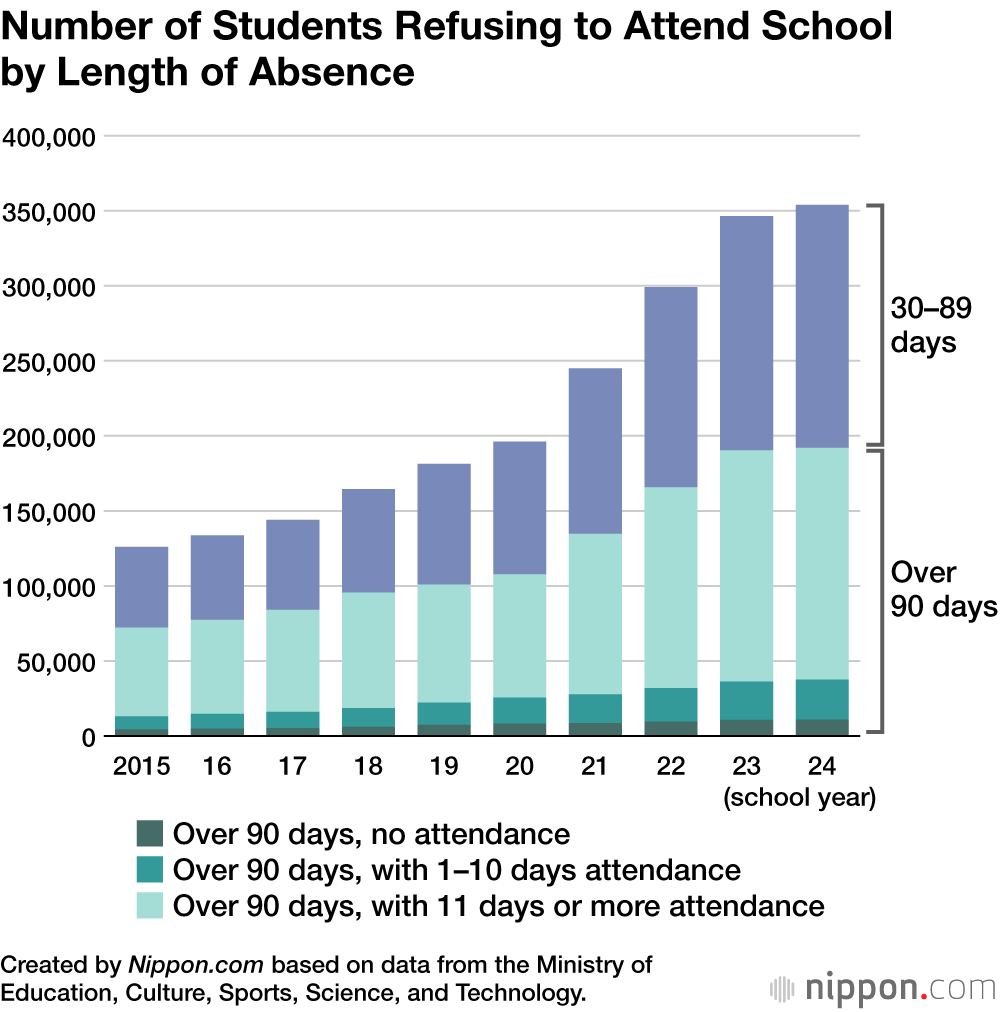
The statistics on futoko - school refusal - provide context for why that recognition is now urgent. Japan Times reporting from 2025 documents levels of school non-attendance concentrated among middle and high school students that represent a genuine social emergency, with the numbers continuing to rise despite years of policy attention (Japan Times, 2025). The causes are multiple and contested, but the pattern is consistent with what the research on chronic academic stress and regulatory depletion would predict: a cohort of adolescents whose nervous systems have been pushed past sustainable thresholds to the point where the basic act of attending school has become neurobiologically aversive. I would argue that we should not think of futoko, in most cases, as a behavioral choice, but instead as a biological regulatory response.
For IB schools operating in Japan, the challenge is culturally specific in a way that matters for how we design interventions. Research published in Frontiers in Psychology identifies a meaningful distinction between "performance-based" academic anxiety, which is characteristic of many Western educational contexts, and "shame-based" academic anxiety, which is more prevalent in East Asian environments shaped by filial piety, collective face, and the weight of intergenerational educational aspiration (Guo et al., 2022). In shame-based anxiety, the regulatory burden on a student is not merely about their own performance; it encompasses their family's honor, their parents' sacrifices, and their perceived position within a social hierarchy that extends well beyond the classroom. That is a fundamentally different cognitive and emotional load, even when the surface behavior - a student who appears anxious and avoidant - looks the same.
The regulatory approaches that work in one cultural context are not automatically transferable to the other, and the IB's well-being frameworks should be applied with this in mind. Academic analysis of the IB's role as a reform vehicle within the Japanese state system points to a genuine opportunity: the IB's explicit Learner Profile values offer a legitimate cultural bridge and a framework for arguing that student well-being is not a Western import but a precondition for the kinds of capable, adaptive graduates that Japan's changing economy increasingly needs (Iwabuchi, 2021).
A consequence here, I believe, is that parent communication is not merely advisable but strategically necessary. The case for well-being as a precondition for learning, rather than as a trade-off against it, needs to be made explicitly, in cultural terms that resonate, and with the kind of institutional authority that schools can bring to bear. The "Parent University" model - structured sessions that give parent communities access to the same neurobiological and learning science frameworks their children's teachers are working from - is an investment in the shared understanding that makes school-level reform sustainable. A balanced student, in this framework, is not a student whose standards have been lowered. They are a student whose brain is biologically available for the highest levels of IB performance. That message is worth delivering clearly and repeatedly, because the cultural default will reassert itself if it is not actively countered.
An architectural brief
I want to close with the reframe that felt most clarifying to me when I was preparing my IBAJ session presentation. The dominant self-conception of school leadership in high-performance educational contexts is that of the "guardian of standards" - the person who holds the line against the erosion of expectations, who resists the pressure to make things easier. I think that there is something valuable and worth preserving in that role - I would not disregard the importance of maintaining high standards in education. But I think this has become insufficient as a complete description of what effective school leadership requires today, and I think its insufficiency (and inefficiency) is producing schools that work harder than they need to for outcomes that are worse than they should be.
What the neuroscience and learning science together describe is a profession that is fundamentally environmental design. The decisions that matter most for student learning outcomes are not primarily decisions about the difficulty of assessments or the quantity of homework - they are decisions about the regulatory environment in which learning occurs: the cognitive architecture of the school day, the temporal structure of the assessment calendar, the emotional register of classroom culture, the design of the digital interface through which learning is mediated, and the metacognitive scaffolding that determines whether students can function as self-directed learners or remain perpetually dependent on external management.
These are architectural decisions. They shape the learning environment the way a building shapes the experience of inhabiting it - invisibly, pervasively, but concretely, measurably, and with compounding effects over time. A school leader who attends carefully to the content of the curriculum while ignoring the neurobiological conditions under which it is encountered has made a category error about where the leverage is. Think about it - the IB Learner Profile actually describes a set of dispositions that are, fundamentally, properties of a well-regulated, cognitively available, metacognitively capable brain. Designing for those dispositions means designing for the conditions that make them biologically possible.
The working definition of rigor I proposed earlier bears repeating here, because every word is doing work: sustained engagement in high-intrinsic-load cognitive tasks, performed within a regulated neurobiological state, characterized by depth of inquiry, iterative mastery, and student agency. The "regulated neurobiological state" is not a "preamble" to the serious stuff. It is the condition that makes the serious stuff possible. The "iterative mastery" is not a lower bar. It is a more accurate model of how expertise actually develops across science, writing, engineering, and every other discipline the IB curriculum encompasses. The "student agency" is not an indulgence. It is the metacognitive ownership without which rigor becomes, at best, managed compliance with someone else's standards.
Rigor without regulation is just stress management; or, more accurately, managing the side effects of stress. We have been measuring the stress and calling it evidence of standards for long enough that the conflation has become invisible. The research and science is clear enough now that retiring it is not a radical act. It is simply an honest and logical one.
What we are building instead - or what I believe we need to be building, in IB schools and in Japanese schools and in every context where we are asking adolescents to do difficult intellectual work - is the environment in which that work is actually possible. Not "easier" - just possible. This is a more demanding, difficult, and complicated mission than traditional approaches to assessment integrity and "difficulty-based" learning design, but it is the morally imperative one - and the only one that has a chance of actually achieving the results we are all after.
References
Official Policy & Frameworks
The Fourth Basic Plan for the Promotion of Education (2023–2027). Government of Japan.
https://www.mext.go.jp/en/policy/education/lawandplan/title01/detail01/1373798.htm
Organisation for Economic Co-operation and Development (OECD). (2019).
The future of education and skills: OECD Learning Compass 2030. OECD Publishing.
https://www.oecd.org/education/2030-project/
Taylor, L., De Neve, J.-E., DeBorst, L., & Khanna, D. (2022).
Well-being in education in childhood and adolescence. International Baccalaureate Organization.
https://www.ibo.org/research/wellbeing-research/well-being-in-education-in-childhood-and-adolescence-2022/
Neuroscience & Neuroregulation
Guo, X., Li, J., Niu, Y., & Luo, L. (2022).
The relationship between filial piety and the academic achievement and subjective wellbeing of Chinese early adolescents: The moderated mediation effect of educational expectations.
Frontiers in Psychology, 13, 747296.
https://doi.org/10.3389/fpsyg.2022.747296
Immordino-Yang, M. H., Darling-Hammond, L., & Krone, C. (2019).
Nurturing nature: How brain development is inherently social and emotional, and what this means for education. Aspen Institute.
Perry, B. D. (n.d.).
Neurosequential Model in Education (NME). Neurosequential Network.
https://www.neurosequential.com/nme
Perry, B. D., & Szalavitz, M. (2017).
The boy who was raised as a dog: And other stories from a child psychiatrist’s notebook (3rd ed.). Basic Books.
Purnell, K. (2025). Stress and the Learning Brain: The neuroendocrinology of academic performance. CQUniversity Research Portal.
Purnell, K. (2026). Calm Brain, Strong Choices: Neuro-informed teaching and leading for thriving students and teams. CQUniversity Press.
Learning Science & Cognitive Load
Rind, I. A. (2026). Conceptualizing the impact of AI on teacher knowledge and expertise: A cognitive load perspective. Education Sciences, 16(1), 57. https://doi.org/10.3390/educsci16010057
Sweller, J. (2023).
The development of cognitive load theory: Replication crises and incorporation of other theories can lead to theory expansion.
Educational Psychology Review, 35, Article 95.
https://doi.org/10.1007/s10648-023-09817-2
The Learning Agency Lab. (2020). Make working memory work for you.
https://the-learning-agency-lab.com/the-learning-curve/make-working-memory-work-for-you/
Structural Reform, Time & Well-being
Challenge Success. (2024). Educational research and publications. Stanford Graduate School of Education affiliate.
https://www.challengesuccess.org/educational-research/
Denizet-Lewis, B. (2019, March 11). The myth of too much homework.
The Atlantic
https://www.theatlantic.com/education/archive/2019/03/homework-research-how-much/585889/
Wheaton, A. G., Chapman, D. P., & Croft, J. B. (2016). School start times, sleep, behavioral, health, and academic outcomes: A review of the literature. Journal of School Health, 86(5), 363–381. https://doi.org/10.1111/josh.12388
Metacognition & Agency
Education Endowment Foundation (EEF). (2025). Metacognition and self-regulated learning: Guidance report (2nd ed.). EEF. https://educationendowmentfoundation.org.uk/education-evidence/guidance-reports/metacognition
Harvard Project Zero. (2025). Making thinking visible: Thinking routines toolkit. Harvard Graduate School of Education. https://pz.harvard.edu/thinking-routines
Cultural & Japan-Specific Context
Guo, X., Li, J., Niu, Y., & Luo, L. (2022). The relationship between filial piety and the academic achievement and subjective wellbeing of Chinese early adolescents: The moderated mediation effect of educational expectations. Frontiers in Psychology, 13, 747296. https://doi.org/10.3389/fpsyg.2022.747296
Iwabuchi, K. (2021). Locus of Japan’s education reform through the internationalization of education: Situating the introduction of the International Baccalaureate in Japan. UTokyo Repository. https://repository.dl.itc.u-tokyo.ac.jp/edu_61_46
Japan Times. (2025, October 29). Elementary and junior high schools see record numbers of students refusing school.
https://www.japantimes.co.jp/news/2025/10/29/japan/record-students-refuse-school/
Japan Times. (2025, March 28). School-age suicides in Japan hit all-time high.
https://www.japantimes.co.jp/news/2025/03/28/japan/society/japan-students-suicides-record-high/